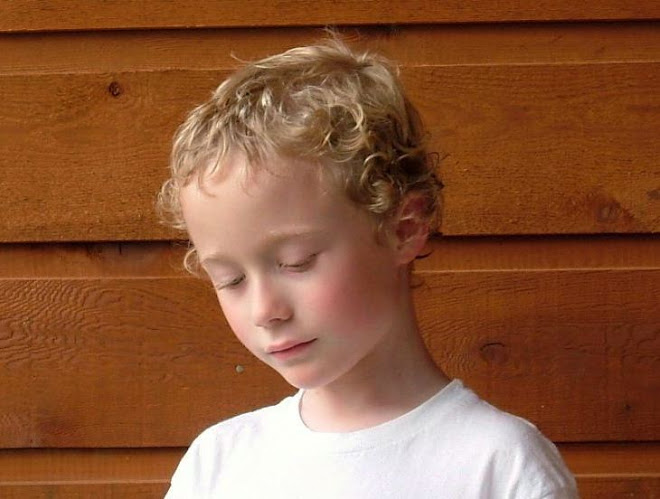
The signs that Blaine Davis wasn't quite like other toddlers came early. Even more than the fact that he didn't play well with others, he lacked the skill to point to what he wanted.
That inability to express his wants and needs meant that he would follow his mother around and cry in frustration.
"He was in his own world,” said his mother, Jennifer Davis.
"He had no way of communicating with us and he would try to communicate by crying and pushing and shoving, not in a mean way, but trying to show us what he wanted.”
But Oklahoma's Early Foundations researchers identified Blaine's autism-type behaviors and got him started in an early intervention program that Steve Davis said has generated unbelievable progress in his son.
One day after Blaine attended the playgroup at a local church, the teachers said he'd told teacher Seth Kastner that he loved him.
"I'd only heard him say, 'I love you,' one other time, that was to me,” Steve Davis said. "Being a parent of a 3-year-old child and not hearing 'I love you' is incredibly difficult.”
Now, Blaine has learned to point, use sign language and even allows his parents to touch him.
The University of Oklahoma Health Sciences Center's pilot project is designed to identify the autism spectrum disorders in toddlers like Blaine.
Like Blaine, one in every 110 children has been diagnosed with the disorders, according to the Centers for Disease Control and Prevention. Researchers found that autism is being reported at higher rates than ever before.
"It's a pretty significant increase in the last 10 years,” Bonnie McBride, principal investigator for the Early Foundations Project, said during a news conference Wednesday at the center.
Though children are often 2 years old by the time their autism is identified, she said the earlier an autistic child is diagnosed the better the outcome.
About the program
The Autism Workforce Initiative is Oklahoma's response to the needs of children, their families and pediatricians.
The initiative features components such as a physician training program, along with the early intervention program for young children suspected of having an autism spectrum disorder.
Children enrolled in the program receive 17 hours per week of help through activities such as play groups, intensive teaching involving behavioral techniques, weekly home visits and monthly parent education nights.
"It's awesome. It's changed our lives, it really has,” Steve Davis said.
Services are provided through Oklahoma's Early Intervention system and the model site serving roughly 10 families in Oklahoma City is funded using federal dollars through the state Department of Education.
Along with developing an intervention model through its pilot site in Oklahoma City, the project is intended to provide outreach support to other communities statewide. The project also is operating in Cleveland and Canadian counties.
The program is offered free to families of all income levels through SoonerStart, the state's early intervention program for infants and toddlers with disabilities and developmental delays.
For more information on the SoonerStart program, call 522-5167 or go to www.okdhs.org/programs andservices/dd/ss.
Read more: http://www.newsok.com/article/3465628?searched=autism&custom_click=search#ixzz0q2FKDK1s
Saturday, June 5, 2010


Michigan insurers should cover autism, experts tell senators looking into impact on families
May 24, 2010 • The Rossman Group
YPSILANTI, Mich. – Autism experts and parents said today at the first of four public hearings that more Michigan children with autism will go untreated unless Michigan insurers help cover medically proven therapies that families can’t afford on their own.
“It’s heartbreaking to learn your child has autism, but to find out your insurance company won’t cover treatments that would allow your child to live a fuller, more independent life – that creates such despair, and thousands of Michigan families are feeling that right now,” said Pamela Lemerand, director of the Autism Collaborative Center at Eastern Michigan University.
The center was the site of the first of the bipartisan hearings spearheaded by Sens. Randy Richardville, R-Monroe, and Tupac A. Hunter, D-Detroit. The lawmakers want to know more about the impact of the complex neurobiological condition on the families of the 15,000 children in Michigan who have autism. Autism impairs a person’s ability to communicate, learn and relate to others.
Autism affects one in every 110 children and is the fastest-growing developmental disability in the country, according to the U.S. Centers for Disease Control. It can be effectively treated with early, intensive intervention such as speech, occupational and physical therapies, and behavioral health therapy, but treatment can cost $50,000 annually.
“We need to know firsthand how this devastating condition affects Michigan families," Richardville said. “It's important to explore various options that may represent an opportunity to help those in need and be more efficient with public funds.”
Insurance companies generally do not cover autism treatment, so 19 states have updated their insurance laws to cover it.
It is estimated that early diagnosis and intervention could save Michigan taxpayers lifetime costs of $14 billion for the current population of autistic children. The savings reflect avoided costs for supports such as long-term care and special education.
“If diagnosed and treated early, children with autism can make significant gains that affect their independence and family functioning in many ways,” said Dr. Catherine Lord, director of the University of Michigan Autism and Communication Disorders Center. “Making sure insurance companies cover early treatment just makes good fiscal sense.”
But it’s also a social injustice that needs to be addressed, Lord said. “What other medical condition with known, medically proven interventions is routinely denied coverage?"
A recent study found the state of Texas could save up to $771.5 million in special education costs alone within just the first 10 years of passing autism insurance reform legislation. In Michigan the savings could be $3 billion over the entire school lives (age 3-26) of the 15,000 children with autism.
“Without insurance reform, Michigan taxpayers will continue to be saddled with these costs and Michigan children won’t have access to medically proven therapies that can be life-changing for them and their families,” said Lorri Unumb, senior policy advisor and counsel for Autism Speaks, a Washington, D.C.-based advocacy group that has helped win legislative reforms in several states.
Plans are under way for additional hearings in Detroit, Grand Rapids and Lansing.
###
Contact: Sharon Emery 517-896-7075 (c), 517-487-9320 (o)
https://rossmangroup.com/newsitem.php?newsid=464
YPSILANTI, Mich. – Autism experts and parents said today at the first of four public hearings that more Michigan children with autism will go untreated unless Michigan insurers help cover medically proven therapies that families can’t afford on their own.
“It’s heartbreaking to learn your child has autism, but to find out your insurance company won’t cover treatments that would allow your child to live a fuller, more independent life – that creates such despair, and thousands of Michigan families are feeling that right now,” said Pamela Lemerand, director of the Autism Collaborative Center at Eastern Michigan University.
The center was the site of the first of the bipartisan hearings spearheaded by Sens. Randy Richardville, R-Monroe, and Tupac A. Hunter, D-Detroit. The lawmakers want to know more about the impact of the complex neurobiological condition on the families of the 15,000 children in Michigan who have autism. Autism impairs a person’s ability to communicate, learn and relate to others.
Autism affects one in every 110 children and is the fastest-growing developmental disability in the country, according to the U.S. Centers for Disease Control. It can be effectively treated with early, intensive intervention such as speech, occupational and physical therapies, and behavioral health therapy, but treatment can cost $50,000 annually.
“We need to know firsthand how this devastating condition affects Michigan families," Richardville said. “It's important to explore various options that may represent an opportunity to help those in need and be more efficient with public funds.”
Insurance companies generally do not cover autism treatment, so 19 states have updated their insurance laws to cover it.
It is estimated that early diagnosis and intervention could save Michigan taxpayers lifetime costs of $14 billion for the current population of autistic children. The savings reflect avoided costs for supports such as long-term care and special education.
“If diagnosed and treated early, children with autism can make significant gains that affect their independence and family functioning in many ways,” said Dr. Catherine Lord, director of the University of Michigan Autism and Communication Disorders Center. “Making sure insurance companies cover early treatment just makes good fiscal sense.”
But it’s also a social injustice that needs to be addressed, Lord said. “What other medical condition with known, medically proven interventions is routinely denied coverage?"
A recent study found the state of Texas could save up to $771.5 million in special education costs alone within just the first 10 years of passing autism insurance reform legislation. In Michigan the savings could be $3 billion over the entire school lives (age 3-26) of the 15,000 children with autism.
“Without insurance reform, Michigan taxpayers will continue to be saddled with these costs and Michigan children won’t have access to medically proven therapies that can be life-changing for them and their families,” said Lorri Unumb, senior policy advisor and counsel for Autism Speaks, a Washington, D.C.-based advocacy group that has helped win legislative reforms in several states.
Plans are under way for additional hearings in Detroit, Grand Rapids and Lansing.
###
Contact: Sharon Emery 517-896-7075 (c), 517-487-9320 (o)
https://rossmangroup.com/newsitem.php?newsid=464
Tuesday, May 25, 2010
Call it anything but Autism!
From our friends at Oklahoma Citizen. Click here to access article.
May 24, 2010 - 7:38 pm by ollamok
Parents many times want their disabled child to have a label. Any label will do. Why? So they know what they are dealing with and can start a plan of attack. Or, can finally put a name to what they have faced for so long. They never dreamed that it could force them into being denied basic insurance coverage for an illness or service, but it can.
Please don’t give up. Please continue to fight. There are still ways to get things covered. It takes a lot of endurance but these types of parents to this everyday anyway.
One must first study their insurance plan. What is covered? That is right! Do not look for what is not covered. Read the guide you are given over and over. Become familiar with diagnostic codes. ICD9 coding is used by most insurance companies. Here is a web site that could be of use: http://icd9cm.chrisendres.com/. The way something is coded is the key to getting insurance to pay for the illness or service.
According to an Occupational Therapist, OT, one specific code not to use is 299.00, which is Autism. The code 783.40 is Developmental Delay, another area that insurance has denied often. The code the OT has received the best payment from is 781.3, Praxis or Motor in Coordination. The code has to relate to a medical need, if insurance is to pay.
Through unique circumstances a teacher noted that my son seemed to have a curved spine. My husband and I thought she was wrong. We finally consulted an Orthopedic Surgeon. This resulted in a prescription for Physical Therapy (PT) services, Social Skills Training and Speech Services. He has Scoliosis. The Doctor wrote the Rx for services based on a need to increase spatial body awareness and the diagnosis of Scoliosis, Asperger’s and Dyssemia. Dyssemia is:
“The term comes from the Greek dys (difficulty) and semia (signal). These difficulties go beyond problems with body language and motor skills ‘A classic set of studies by Albert Mehrabian showed that in face-to-face interactions, 55 percent of the emotional meaning of a message is expressed through facial, postural, and gestural means, and 38 percent of the emotional meaning is transmitted through the tone of voice. Only seven percent of the emotional meaning is actually expressed with word’] Dyssemic persons exhibit difficulties with the acquisition and use of nonverbal cues in interpersonal relationships. Dyssemia represents the social dysfunction aspect of Nonverbal Learning Disorder”
The insurance did pay for PT and the other services were not used at that time. Yet, this was a physical reason to write for these services. This Doctor says he sees Scoliosis in children with Autism a lot. This doesn’t mean to take in all children with Autism to an Orthopedic Surgeon. By all means go through the Primary Care Physician (PCP) first.
What this is saying, is there are reasons other than Autism to bill insurance for services. Insurance will pay for these. One has to look at what insurance will pay for and see if their child has these conditions. Does it seem like a game? Well it just might seem like it. If it does, that means you have a chance of winning. If one does try, there is a 50/50 chance of winning, but if one does not try, the result is a loss.
Do you know what a Carve Out Plan is? Do you know what the Birthday Rule is? Do you know if you insurance company is a PPO or an HMO? One can go to www.parenttoparentnys.org and download a book on understanding insurance. Most states will have guide to Medicaid that tells what is covered .There is another web site that has a guide to understanding private insurance, http://www.healthinsuranceinfo.net/. Knowing these terms will help you when you are navigating the insurance network. A Carve Out Plan will not pay for anything that another plan does not pay for if one has two or more plans. The Birthday Rule is where both parents cover a child, the parents’ birthday that comes first is the primary insurance and the other insurance is secondary. My birthday comes first in the year so if I had insurance then mine would be primary and my husband’s would be the secondary.
Other things to bear in mind besides what to call it, believe are not are the geography of where you live. Some states mandate coverage for Autism. If they do cover Autism one might still want to consider calling it something else. What are the caps these states have put on covering Autism? Some have put it at very low. That means the insurance companies win and you lose. These are just things to consider. Just check on what the dollar amount is.
A New York Times articleA Road Map to Help Parents Deal with Financial Burden of Autism, talks about fighting insurance to pay for Autism and stretching the Autism dollar. Of course one needs to keep copies of all records: Explanations of Benefits, Doctors Receipts and other documents such as denial letters. What the article states about stretching the Autism dollar is if the services one gets at school, such as Occupational Therapy(OT), PT and Speech are good, then one can saves the other dollars to pay for out of pockets expenses not covered by insurance where needed.
Insurance often requires one to go all the way through the process of getting a denial and through the appeals process. Sometimes it helps to talk with the State Insurance office. This is not a guarantee and one may have to sue with a lawyer. Remember getting a lawyer may cost money. Even if one does attempt to sue for coverage it is not a given that one will win and sometimes it is good to know when to quit or give up the process. It may cost too much money to pay a lawyer and loose that money too. Please make the best informed decisions for your family.
Playing the insurance game is no fun. I hope this article has brought some strategy to your side. Paying for Autism is a never ending process. Remember call it anything but Autism. Look for something real that your child has, this should be easy. I pray that I have helped you in some way. Bless you for allowing me to share in your trials and blessings.
May 24, 2010 - 7:38 pm by ollamok
Parents many times want their disabled child to have a label. Any label will do. Why? So they know what they are dealing with and can start a plan of attack. Or, can finally put a name to what they have faced for so long. They never dreamed that it could force them into being denied basic insurance coverage for an illness or service, but it can.
Please don’t give up. Please continue to fight. There are still ways to get things covered. It takes a lot of endurance but these types of parents to this everyday anyway.
One must first study their insurance plan. What is covered? That is right! Do not look for what is not covered. Read the guide you are given over and over. Become familiar with diagnostic codes. ICD9 coding is used by most insurance companies. Here is a web site that could be of use: http://icd9cm.chrisendres.com/. The way something is coded is the key to getting insurance to pay for the illness or service.
According to an Occupational Therapist, OT, one specific code not to use is 299.00, which is Autism. The code 783.40 is Developmental Delay, another area that insurance has denied often. The code the OT has received the best payment from is 781.3, Praxis or Motor in Coordination. The code has to relate to a medical need, if insurance is to pay.
Through unique circumstances a teacher noted that my son seemed to have a curved spine. My husband and I thought she was wrong. We finally consulted an Orthopedic Surgeon. This resulted in a prescription for Physical Therapy (PT) services, Social Skills Training and Speech Services. He has Scoliosis. The Doctor wrote the Rx for services based on a need to increase spatial body awareness and the diagnosis of Scoliosis, Asperger’s and Dyssemia. Dyssemia is:
“The term comes from the Greek dys (difficulty) and semia (signal). These difficulties go beyond problems with body language and motor skills ‘A classic set of studies by Albert Mehrabian showed that in face-to-face interactions, 55 percent of the emotional meaning of a message is expressed through facial, postural, and gestural means, and 38 percent of the emotional meaning is transmitted through the tone of voice. Only seven percent of the emotional meaning is actually expressed with word’] Dyssemic persons exhibit difficulties with the acquisition and use of nonverbal cues in interpersonal relationships. Dyssemia represents the social dysfunction aspect of Nonverbal Learning Disorder”
The insurance did pay for PT and the other services were not used at that time. Yet, this was a physical reason to write for these services. This Doctor says he sees Scoliosis in children with Autism a lot. This doesn’t mean to take in all children with Autism to an Orthopedic Surgeon. By all means go through the Primary Care Physician (PCP) first.
What this is saying, is there are reasons other than Autism to bill insurance for services. Insurance will pay for these. One has to look at what insurance will pay for and see if their child has these conditions. Does it seem like a game? Well it just might seem like it. If it does, that means you have a chance of winning. If one does try, there is a 50/50 chance of winning, but if one does not try, the result is a loss.
Do you know what a Carve Out Plan is? Do you know what the Birthday Rule is? Do you know if you insurance company is a PPO or an HMO? One can go to www.parenttoparentnys.org and download a book on understanding insurance. Most states will have guide to Medicaid that tells what is covered .There is another web site that has a guide to understanding private insurance, http://www.healthinsuranceinfo.net/. Knowing these terms will help you when you are navigating the insurance network. A Carve Out Plan will not pay for anything that another plan does not pay for if one has two or more plans. The Birthday Rule is where both parents cover a child, the parents’ birthday that comes first is the primary insurance and the other insurance is secondary. My birthday comes first in the year so if I had insurance then mine would be primary and my husband’s would be the secondary.
Other things to bear in mind besides what to call it, believe are not are the geography of where you live. Some states mandate coverage for Autism. If they do cover Autism one might still want to consider calling it something else. What are the caps these states have put on covering Autism? Some have put it at very low. That means the insurance companies win and you lose. These are just things to consider. Just check on what the dollar amount is.
A New York Times articleA Road Map to Help Parents Deal with Financial Burden of Autism, talks about fighting insurance to pay for Autism and stretching the Autism dollar. Of course one needs to keep copies of all records: Explanations of Benefits, Doctors Receipts and other documents such as denial letters. What the article states about stretching the Autism dollar is if the services one gets at school, such as Occupational Therapy(OT), PT and Speech are good, then one can saves the other dollars to pay for out of pockets expenses not covered by insurance where needed.
Insurance often requires one to go all the way through the process of getting a denial and through the appeals process. Sometimes it helps to talk with the State Insurance office. This is not a guarantee and one may have to sue with a lawyer. Remember getting a lawyer may cost money. Even if one does attempt to sue for coverage it is not a given that one will win and sometimes it is good to know when to quit or give up the process. It may cost too much money to pay a lawyer and loose that money too. Please make the best informed decisions for your family.
Playing the insurance game is no fun. I hope this article has brought some strategy to your side. Paying for Autism is a never ending process. Remember call it anything but Autism. Look for something real that your child has, this should be easy. I pray that I have helped you in some way. Bless you for allowing me to share in your trials and blessings.
Monday, May 10, 2010
Autistic kids receive fair treatment with new bill

Sen. Sean Burrage
May 10, 2010
Pryor Daily Times
OKLAHOMA CITY — Starting Nov. 1, parents of children with autism will have greater protection when it comes to more fair treatment by insurance companies. Senate Bill 2045 was approved on bipartisan votes in the Senate and the House and has been approved by the governor. The measure includes language that will make certain health insurance companies cover the same illnesses and medical treatment for children with autism as they do for children who do not have that diagnosis.
To be clear, we are not talking about covering diagnosis and treatment of autism itself, although I believe this is something the state can and should do. We’re specifically talking about families that have insurance, regularly pay their premiums, but when a medical condition affects a child with autism, the insurance company refuses to pay for treatment of that condition, even though the medical problem has nothing to do with autism.
We’ve had literally dozens of families complain that insurance companies had routinely denied claims filed on behalf of their children for illnesses and maladies
completely unrelated to the diagnosis of autism. According to the families, their claims were denied because Oklahoma does not require health insurance policies to cover the diagnosis and treatment of autism, and most insurers will specifically exclude autism.
Another way to put it is this. Two families have the same insurance policy. Both have sons who play a sport. The boy from the first family is hurt playing baseball. The insurance covers the cost of treatment; end of story. But for the second family, if their child is injured playing baseball, the outcome is different. Their medical claims are denied because their son happens to have been diagnosed with autism - even that had nothing at all to do with the getting hurt while playing baseball. With the passage of SB 2045 and the governor’s signature, this lack of insurance parity will no longer be legal in Oklahoma.
Autism continues to be the fastest growing developmental disability in our nation, with as many as one in 110 children impacted by one of the conditions on the autism disorder spectrum. Science still has not determined the cause of autism, but we do know that early diagnosis and access to appropriate therapy and treatment can mean the difference between night and day in helping these children lead fuller lives.
This is the result of hard work and cooperation. The idea began as a bill by Sen. Jay Paul Gumm of Durant, who has pushed for enactment of “Nick’s Law.” While he hasn’t given up on that effort to require coverage for diagnosis and treatment of autism, he came up with this common sense compromise everyone could support, even those who oppose “Nick’s Law.” He worked with Senate President Pro Tempore Glenn Coffee, who agreed to help get the compromise in a bill.
This is important step - but we have more to do. I still believe our public policy should be stronger and that our state should do a better job of supporting and protecting the rights of families with autistic children, in terms of available services, medical care, and fair treatment by insurance companies.
Thanks again for reading my “Senate Review.” If you have any questions on a
legislative matter, please do not hesitate to contact my Senate office at the Capitol by calling (405) 521-5555 or writing me with your concerns at: Senator Sean Burrage, 2300 North Lincoln Blvd. Rm. 529-B State Capitol Building, Oklahoma City, OK 73105.
I always enjoy hearing from my constituents and consider it an honor to be your voice in the Oklahoma State Senate. May God bless each of you.
Click here to link to the article.
Thursday, May 6, 2010
Mo. Senate passes autism insurance mandate
Associated Press - May 6, 2010 1:14 PM ET
JEFFERSON CITY, Mo. (AP) - Senators have passed what they describe as a compromise bill to require insurance coverage of autism treatment for children.
The legislation would require group insurance policies regulated by the state to cover up to $45,000 annually for behavioral therapy for autistic children through age 18. The mandate would begin Jan. 1.
Senators passed the bill 27-6 Thursday. It now goes back to the House, which had passed a version with lower coverage caps earlier this year.
The annual coverage caps would apply only to "applied behavioral analysis," an intensive therapy that some parents say produces dramatic improvements in their autistic children.
JEFFERSON CITY, Mo. (AP) - Senators have passed what they describe as a compromise bill to require insurance coverage of autism treatment for children.
The legislation would require group insurance policies regulated by the state to cover up to $45,000 annually for behavioral therapy for autistic children through age 18. The mandate would begin Jan. 1.
Senators passed the bill 27-6 Thursday. It now goes back to the House, which had passed a version with lower coverage caps earlier this year.
The annual coverage caps would apply only to "applied behavioral analysis," an intensive therapy that some parents say produces dramatic improvements in their autistic children.
Saturday, April 24, 2010
A time to highlight accomplishments of those dealing and living with autism
Kim Dabney
Special to the Progress
April 24, 2010
CLAREMORE — What do labels such as “American Indian,” “Jewish,” “Jehovah’s Witness,” “disabled” and “Polish” have in common? They describe wonderful groups of people denoting their faith, culture, condition or heritage. These labels also subjected millions to persecution and death.
For the past 30 years, the United States recognizes April as National Autism Awareness month.
A time to highlight the accomplishments made in healing, dealing, and living with autism.
As the headlines roll in this month it appears we are slipping back to fear of the label and the denial of common rights or dignity to those who must bear it.
Recently, in Oklahoma City, a hospital refused admission to Stephen Puckett, a 28 year-old with autism suffering severe seizures. The reason; he is an adult with autism.
These same hospitals take drug addicts, murderers, rapists, mentally ill, black, white, Hispanic, male and female but not autistic adults.
As a parent of an autistic child the message that several hospitals state as ‘policy’ chills me to the bone. Our son Drew has autism and is only eight years away from reaching the legal age of adulthood. How will this ‘policy’ affect him and others like him?
Drew regressed into autism at age 16 months, leaving him in “label limbo” with pediatricians who shrug their shoulders about how to help him and education systems that do not want to teach him.
Health insurance companies that my husband and I paid premiums into for years do not cover Drew’s health and well-being if it is in connection to his autism. Life insurance companies will not write a child rider for him. There is no escaping the label. These acts of exclusion happen almost everywhere.
There are a few standout exceptions: notably, Roosa Elementary school in Claremore.
The teachers, therapists and staff do not measure Drew by his autism label. They see him as a smart, loving little boy who likes to swing, play with rocks and mud, go to the zoo and do math.
His teachers and therapists marvel at how well he is doing. They push him hard to learn how to read, write and count.
They think he has a future and is worthy of an education. They are doing something remarkable in that they have refused to judge him by the label. They see a growing little boy who wants to learn, have friends and play like other children.
What is equally significant are the other children at Roosa, the typically developing ‘normal’ children, his peer group. These children accept Drew, no qualms or hesitations. They quickly learn how to communicate with Drew, who is non-verbal.
They play with Drew and he loves it. Drew’s autism label does not get in the way. What resourceful adults these Roosa Elementary children will turn out to be.
They will be able to work with all type of people, never seeing the differences as the person, but the person behind it all. They will be first-rate communicators, good neighbors, incredible in the work force, already able to get along regardless of the disparity of a less than desired label.
Perhaps that explains what happened to Stephen. His label of autism met up with folks in authority who do not ‘do’ autism.
Possibly, if they had grown up with children in their classroom and playgrounds and learned to see the person, not the label, Stephen would have received care for his seizure and compassion that his autism makes it harder on him to understand what is going on.
Maybe the “universal government health care” that our elected officials are forcing its way to reality will put an end to situations like those that Stephen went through.
Maybe not. England is a civilized country similar to America that has had ‘free health care” since 1948. Does their system treat the person or the label?
A short while ago in England, Mr. and Mrs. Roberts’ 20 year old son, Harry Horne Roberts, was living in a group home.
Harry had autism. His devoted and caring parents took care of him at home until he was an adult. At age 18, they had safety concerns for Harry and moved him to an assisted living facility where they visited him four or five days a week.
A serious medical decision, made without Mr. or Mrs. Roberts’ knowledge or consent, to put the young man on the drug Chlorpromazine ended Harry’s life.
This dangerous anti-psychotic drug can cause brain damage, sudden death, heart failure and is not a proven or approved treatment for autism. Harry died in his sleep this past December. He was very healthy, active but not psychotic. He was simply autistic.
As a parent of a child with autism, Harry’s suspicious death and Stephen’s denial of medical care present horrifying questions. What is going to happen to my child when he is no longer legally a minor?
Parents of children with any disability that continues to affect them as they mature to adults are faced with the gruesome reality that care for their adult children may be denied or taken over by the state. After years of sacrifice, love, devotion, care, and advocating, we may have our adult child deemed unworthy of medical care or even worse, legally killed with ghastly chemical cocktails prescribed by the state.
Autism Awareness month is almost over and the label of autism is still misunderstood. If you know someone with autism or who has an autistic child, take a moment to see the real person. They may have some quirky characteristics. Do not let that distract you from seeing the real live human being that longs to be in your eyes, more than a lousy label.
n Kim Dabney is the parent of a son with autism.
click here to read the article.
Special to the Progress
April 24, 2010
CLAREMORE — What do labels such as “American Indian,” “Jewish,” “Jehovah’s Witness,” “disabled” and “Polish” have in common? They describe wonderful groups of people denoting their faith, culture, condition or heritage. These labels also subjected millions to persecution and death.
For the past 30 years, the United States recognizes April as National Autism Awareness month.
A time to highlight the accomplishments made in healing, dealing, and living with autism.
As the headlines roll in this month it appears we are slipping back to fear of the label and the denial of common rights or dignity to those who must bear it.
Recently, in Oklahoma City, a hospital refused admission to Stephen Puckett, a 28 year-old with autism suffering severe seizures. The reason; he is an adult with autism.
These same hospitals take drug addicts, murderers, rapists, mentally ill, black, white, Hispanic, male and female but not autistic adults.
As a parent of an autistic child the message that several hospitals state as ‘policy’ chills me to the bone. Our son Drew has autism and is only eight years away from reaching the legal age of adulthood. How will this ‘policy’ affect him and others like him?
Drew regressed into autism at age 16 months, leaving him in “label limbo” with pediatricians who shrug their shoulders about how to help him and education systems that do not want to teach him.
Health insurance companies that my husband and I paid premiums into for years do not cover Drew’s health and well-being if it is in connection to his autism. Life insurance companies will not write a child rider for him. There is no escaping the label. These acts of exclusion happen almost everywhere.
There are a few standout exceptions: notably, Roosa Elementary school in Claremore.
The teachers, therapists and staff do not measure Drew by his autism label. They see him as a smart, loving little boy who likes to swing, play with rocks and mud, go to the zoo and do math.
His teachers and therapists marvel at how well he is doing. They push him hard to learn how to read, write and count.
They think he has a future and is worthy of an education. They are doing something remarkable in that they have refused to judge him by the label. They see a growing little boy who wants to learn, have friends and play like other children.
What is equally significant are the other children at Roosa, the typically developing ‘normal’ children, his peer group. These children accept Drew, no qualms or hesitations. They quickly learn how to communicate with Drew, who is non-verbal.
They play with Drew and he loves it. Drew’s autism label does not get in the way. What resourceful adults these Roosa Elementary children will turn out to be.
They will be able to work with all type of people, never seeing the differences as the person, but the person behind it all. They will be first-rate communicators, good neighbors, incredible in the work force, already able to get along regardless of the disparity of a less than desired label.
Perhaps that explains what happened to Stephen. His label of autism met up with folks in authority who do not ‘do’ autism.
Possibly, if they had grown up with children in their classroom and playgrounds and learned to see the person, not the label, Stephen would have received care for his seizure and compassion that his autism makes it harder on him to understand what is going on.
Maybe the “universal government health care” that our elected officials are forcing its way to reality will put an end to situations like those that Stephen went through.
Maybe not. England is a civilized country similar to America that has had ‘free health care” since 1948. Does their system treat the person or the label?
A short while ago in England, Mr. and Mrs. Roberts’ 20 year old son, Harry Horne Roberts, was living in a group home.
Harry had autism. His devoted and caring parents took care of him at home until he was an adult. At age 18, they had safety concerns for Harry and moved him to an assisted living facility where they visited him four or five days a week.
A serious medical decision, made without Mr. or Mrs. Roberts’ knowledge or consent, to put the young man on the drug Chlorpromazine ended Harry’s life.
This dangerous anti-psychotic drug can cause brain damage, sudden death, heart failure and is not a proven or approved treatment for autism. Harry died in his sleep this past December. He was very healthy, active but not psychotic. He was simply autistic.
As a parent of a child with autism, Harry’s suspicious death and Stephen’s denial of medical care present horrifying questions. What is going to happen to my child when he is no longer legally a minor?
Parents of children with any disability that continues to affect them as they mature to adults are faced with the gruesome reality that care for their adult children may be denied or taken over by the state. After years of sacrifice, love, devotion, care, and advocating, we may have our adult child deemed unworthy of medical care or even worse, legally killed with ghastly chemical cocktails prescribed by the state.
Autism Awareness month is almost over and the label of autism is still misunderstood. If you know someone with autism or who has an autistic child, take a moment to see the real person. They may have some quirky characteristics. Do not let that distract you from seeing the real live human being that longs to be in your eyes, more than a lousy label.
n Kim Dabney is the parent of a son with autism.
click here to read the article.
Autism law draws advocates' praise
Previously, insurers could deny coverage for unrelated treatments.
By SUSAN HYLTON World Staff Writer
4/24/2010
Advocates for children with autism say that a bill signed into law Friday by Gov. Brad Henry is a good first step toward parity in health coverage for the disorder.
The legislation, added to Senate Bill 2045, requires health insurers to cover the same illnesses for autistic children as they do for children without the condition. The law came about after parents reported that medical coverage was denied for services having nothing to do with autism, such as playground injuries.
"This is a bill to stop any restrictions or discrimination against individuals with autism from medical or surgical procedures that are currently covered," said Wayne Rohde, whose 12-year-old son Nick was diagnosed with severe regressive autism when he was 4.
"The insurance companies needed to stop this discrimination. The leadership of both parties decided it wasn't right."
Rohde said insurance companies were limiting coverage for occupational and speech therapy for autistic children but not imposing those limitations for children without autism seeking the same treatment.
In one case, an autistic child was denied coverage for asthma treatments while an asthmatic child without autism was covered, Rohde said.
Christina Newendorp, development director at the Autism Center of Tulsa, who has two sons with autism, said parents had to decide whether they really wanted a diagnosis that could be used as a reason to reject medical claims.
Newendorp said the law won't require all insurance companies to cover the most effective treatments for autism, known as applied behavioral analysis, which can cost $2,000 to $4,000 a month.
That coverage was part of the 2009 failed legislation known as Nick's Law, named for Rohde's son.
"It doesn't address the larger issue of insurers out there who don't cover (autism) as a medical condition whatsoever," she said. "There's no logical reason for insurance companies not to consider autism a medical disorder. We're surrounded by states taking action on this issue. Oklahoma is dragging its feet."
With an estimated 1 in 150 children being diagnosed with an autism spectrum disorder, there could be a tidal wave of disabled adults in the future if nothing is done, Newendorp said.
"If we take action now, we can help turn these children's lives around so they can become independent adults," she said.
Rohde said that, with treatment, Nick moved from a severe form of autism to the middle of the spectrum.
He is still nonverbal, but he now recognizes words, feeds and dresses himself and is not completely dependent on others for his care.
He also plays with his twin brother, Austin, who does not have autism, his father said.
"Austin is very proud and introduces him to the neighborhood kids," Rohde said. "Austin knows how to communicate with him."
Click here to read the article.
By SUSAN HYLTON World Staff Writer
4/24/2010
Advocates for children with autism say that a bill signed into law Friday by Gov. Brad Henry is a good first step toward parity in health coverage for the disorder.
The legislation, added to Senate Bill 2045, requires health insurers to cover the same illnesses for autistic children as they do for children without the condition. The law came about after parents reported that medical coverage was denied for services having nothing to do with autism, such as playground injuries.
"This is a bill to stop any restrictions or discrimination against individuals with autism from medical or surgical procedures that are currently covered," said Wayne Rohde, whose 12-year-old son Nick was diagnosed with severe regressive autism when he was 4.
"The insurance companies needed to stop this discrimination. The leadership of both parties decided it wasn't right."
Rohde said insurance companies were limiting coverage for occupational and speech therapy for autistic children but not imposing those limitations for children without autism seeking the same treatment.
In one case, an autistic child was denied coverage for asthma treatments while an asthmatic child without autism was covered, Rohde said.
Christina Newendorp, development director at the Autism Center of Tulsa, who has two sons with autism, said parents had to decide whether they really wanted a diagnosis that could be used as a reason to reject medical claims.
Newendorp said the law won't require all insurance companies to cover the most effective treatments for autism, known as applied behavioral analysis, which can cost $2,000 to $4,000 a month.
That coverage was part of the 2009 failed legislation known as Nick's Law, named for Rohde's son.
"It doesn't address the larger issue of insurers out there who don't cover (autism) as a medical condition whatsoever," she said. "There's no logical reason for insurance companies not to consider autism a medical disorder. We're surrounded by states taking action on this issue. Oklahoma is dragging its feet."
With an estimated 1 in 150 children being diagnosed with an autism spectrum disorder, there could be a tidal wave of disabled adults in the future if nothing is done, Newendorp said.
"If we take action now, we can help turn these children's lives around so they can become independent adults," she said.
Rohde said that, with treatment, Nick moved from a severe form of autism to the middle of the spectrum.
He is still nonverbal, but he now recognizes words, feeds and dresses himself and is not completely dependent on others for his care.
He also plays with his twin brother, Austin, who does not have autism, his father said.
"Austin is very proud and introduces him to the neighborhood kids," Rohde said. "Austin knows how to communicate with him."
Click here to read the article.
Subscribe to:
Posts (Atom)

 Posts
Posts


